
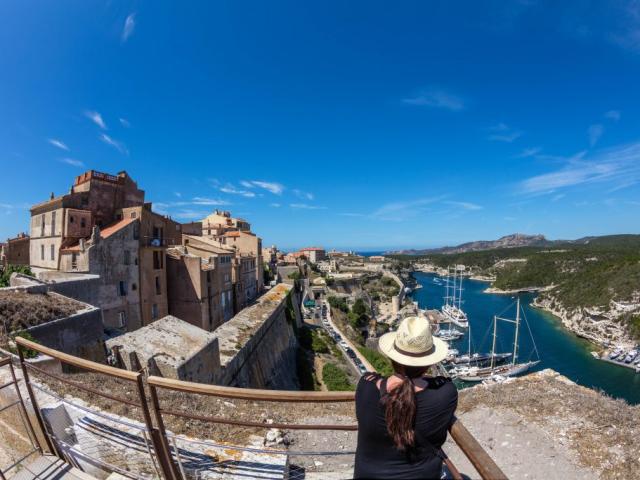
From the islets of the Strait of Bonifacio to the seabed, from the coastline to the maquis, many species find the conditions they need to thrive here. Some are endemic, rare or protected. All contribute to the richness of Bonifacio’s natural heritage.

Fond Marins Bonifacio
Remarkable biodiversity to observe and protect
In the air

Cormorant, Hoopoe, Standing, Bonifacio
Mediterranean crested cormorant, Desmarest’s cormorant
Phalacrocorax aristotelis desmarestii (Payraudeau, 1826)Its distinctive feature
Smaller than the Great Cormorant, Desmarest’s Crested Cormorant is a subspecies endemic to the Mediterranean which, on the French coast, breeds only in Corsica.
How to recognise it?
By its black plumage with a green iridescence and its elegant spring crest. To dry its non-waterproof plumage, it spreads its wings when perching on rocks.
Its remarkable ability
As a fish-eater, it is capable of diving to depths of up to 80 metres and holding its breath for a minute.
The figure
Around 700 pairs nest on the islets within the reserve, accounting for 7 per cent of the global population — making the Strait of Bonifacio one of the world’s most important sites for this species.
How to help protect it
The Crested Cormorant is particularly sensitive to disturbance, especially during the breeding season.
Whether on land or at sea, keep your distance from the birds and their colonies, slow down when near cliffs, and avoid making noise.
Also, take your rubbish and fishing lines away with you.
Observing without disturbing is already a form of protection.
We would like to remind you that flying drones over the Bouches de Bonifacio Nature Reserve is strictly prohibited.
Common puffin
Calonectris borealis (Cory, 1881)Its jointed structure
A member of the albatross family, this seabird with long, supple wings only lands on land to breed.
How to recognise it?
An imposing seabird with narrow, long wings, grey-brown above and white with brown edging below. Up close, the breast, nape and head are grey, and the beak is pale yellow with a dark tip.
Its remarkable ability
In the evening, around the islands, the puffins return to their burrows, uttering hoarse, mesmerising cries, likened to wails or children’s sobs — a unique nocturnal auditory spectacle.
Facts
Highly faithful to their nesting sites and their mates, puffins can live for over 30 years.
What you can do to help
The Manx shearwater is particularly vulnerable when it returns to land to its breeding burrow.
Near the islands and colonies, keep your distance, reduce your speed when boating, and avoid noise and night-time lighting.
Do not approach the burrows and keep dogs on a lead.
Take your rubbish and fishing lines away with you: preserving the puffins’ peace and quiet means protecting their breeding.

Puffin Cendre 2 Bonifacio
Underwater and along the coast

Serran Ecriture 2 Bonifacio
Corsican name: barchetta
Serran handwriting
Serranus scribaIts distinctive feature
Its head and gills are adorned with blue and red patterns reminiscent of Arabic calligraphy, hence its name.
How can you recognise it?
Its silvery body is streaked with irregular dark vertical bands.
Its remarkable ability
It is a synchronous hermaphrodite (capable of being both male and female), which occasionally allows it to fertilise its own eggs and explains its solitary nature.
The figure
The Serran can be found at depths of 0 to 30 metres near Posidonia seagrass beds and shallow rocks.
How to help protect it
When diving or snorkelling, observe it without chasing, touching or feeding it.
When out on a boat, it is forbidden to drop anchor in Posidonia seagrass beds.
Please also follow fishing regulations and do not leave any fishing line, hooks or rubbish in the sea.
Corsican name: a patella gigante
Giant limpet
Patella ferruginea (Gmelin, 1791)Its distinctive feature
The animal is protected by a shell made from seawater and carbon dioxide, most of which has been converted into limestone, attached to the back of the mollusc’s head by a ‘mantle’.
How to recognise it?
Its shell has numerous converging ribs and crenellated edges. The inside is pearly and coloured.
Its remarkable abilities
It can travel up to 5 metres from its resting place to feed, preferably at night. When doing so, it stores water that allows it to survive for several days without air. It finds its way back to its habitat by following a trail it leaves on the rock.
The figure
The largest known specimen measures 10 cm in length.
How to help protect it
Strictly protected species: do not remove it from its rock, do not pick it up and do not disturb it.
Every individual counts for the survival of the species.
Let’s observe it without touching it and protect its rocky habitat.

Giant Scallop 2 Bonifacio

Posidonia in Bonifacio
Corsican name: a fulasca or erba marina
Posidonia
Posidonia oceanicaIts distinctive features
Posidonia is not a seaweed. It is an underwater flowering plant, endemic to the Mediterranean, with roots, rhizomes and ribbon-like leaves that can grow up to 80 cm long.
How can you recognise it?
It forms vast seagrass meadows between the surface and a depth of 40 m.
Its remarkable ability
It produces up to 14 litres of oxygen per day — hence its nickname, ‘the lungs of the Mediterranean’.
The figure
The Posidonia seagrass meadow in the Strait of Bonifacio covers 11,500 hectares.
What you can do to help preserve it
Posidonia is a protected species and particularly fragile.
If you’re out in a boat, you must not anchor in the seagrass beds: opt for sandy seabeds or the buoys provided for this purpose.
On beaches, washed-up leaves are a natural occurrence and help to hold the sand in place. Let’s keep them there.
On the ground

Hermann's Tortoise 2, Bonifacio
Corsican name: a cuppulata
Hermann’s tortoise
Testudo hermanni hermanni (Gmelin, 1789)What makes it special
It is the only tortoise found in mainland France.
How can you recognise it?
It has an oval, domed shell spotted with yellow and black patterns with regular outlines. A spur (claw) is visible at the tip of its tail.
Its remarkable abilities
It uses different habitats depending on the time of day and the season, and according to its activity: feeding, breeding, resting and hibernation.
The figure
It needs around 10 hectares to live.
What you can do to help protect it
The Hermann’s tortoise is particularly vulnerable to disturbance and the destruction of its habitat.
If you come across one, observe it from a distance: do not touch it, do not move it and never pick it up.
Keep dogs on a lead, stay on the paths and be careful on the roads.
Preserving natural habitats and preventing fires helps to protect this tortoise, which can live for up to 50 years.
Velvety Silene
Silene velutinaWhat makes it special
This plant, endemic to Corsica and Sardinia, is found only in southern Corsica and the Maddalena archipelago.
How to recognise it?
This perennial species, with leaves entirely covered in tiny hairs giving them a velvety appearance, flowers between May and July.
Its remarkable ability
It withstands sea spray and strong sunlight.
The figures
Around twenty locations, either on islands or along the coast, are known in Corsica, including seven in the Bonifacio area.
What you can do to help protect it
The velvet silene is an extremely rare plant, found only in Corsica and Sardinia.
To protect it, stay on the paths, avoid trampling on areas where it grows and never pick its flowers.
Do not collect any seeds or seedlings.
In Bonifacio, every population counts: admiring this plant without touching it helps to preserve a unique part of the world’s natural heritage.

Silene Veloute 2 Bonifacio

Arrigoni 2 Bonifacio ferrule
Corsican name: a ferula
Arrigoni’s ferrule
Ferula arrigonii BocchieriWhat makes it special
It grows only in Corsica and Sardinia.
How can you recognise it?
The numerous leaves are supple and deeply lobed. The stem is round and very thick. It ends in numerous branches bearing golden-yellow umbels.
Its remarkable properties
When thoroughly dried, the stems become very hard and strong and can be used as stakes or walking sticks. Its pith can be used as tinder to keep a fire alight.
Facts
Arrigoni’s ferule can grow up to 3 metres tall.
How to look after it
Admire it without picking or eating it: despite its resemblance to fennel, the Arrigoni ferule is not edible and its latex can be toxic, particularly to herbivorous animals.
Let’s preserve it in its natural habitat.
Good habits for protecting living things
Observing the flora and fauna of Bonifacio is a privilege that requires a few precautions.
Respecting the species, their habitats and the regulations ensures that everyone can enjoy this natural wealth without damaging it.
Picto Corail
Do not collect any species
It is forbidden to collect protected plant and animal species.
Please observe the rules regarding dogs
Dogs are not allowed on the islands. In areas where they are permitted, keep them on a lead to avoid disturbing the flora and fauna.
Comply with recreational fishing regulations
Before fishing, check with the Corsican Environment Agency for information on the species, minimum sizes, closed seasons, quotas and designated areas.